

Singlemode vs Multimode Fiber - What is the Difference?
Even among people well versed in fiber optics, sometimes the differences between singlemode and multimode fiber are a bit unclear. That gap matters: the choice affects reach, bandwidth, optics cost, connector types, and how links are tested and maintained in the field. Picking the wrong type can limit performance or add avoidable expense; picking the right one aligns your design with the application. This blog explains each option and outlines the key differences so you can specify, install, and support the right fiber for the job.
What They Are - Two Ways to Guide Light
Singlemode (SM) fiber has a very small core (≈8–10 µm) that carries light in essentially one path or “mode.” Because there’s only one path, the signal doesn’t spread out much as it travels, so singlemode is ideal for long distances and high bit rates. You’ll see it in outside plant, long campus runs, metro/backbone links, PON/FTTH, and increasingly in hyperscale data centers. Common designations are OS1/OS2 (OS2 being low-loss, outdoor-rated).
Multimode (MM) fiber has a larger core (typically 50 µm today; legacy 62.5 µm still exists) that supports many light paths at once. Those multiple paths arrive at slightly different times, which limits reach at higher speeds. However, it also enables lower-cost optics and very fast links over shorter distances. Multimode dominates inside buildings, machine rooms, and data center rows. Designations are OM1 (62.5 µm), OM2/OM3/OM4/OM5 (50 µm), with OM3/OM4 optimized for 850 nm lasers and OM5 supporting shortwave wavelength-division multiplexing (SWDM).
The Practical Differences That Affect Projects
Core size & connectors: Singlemode’s small core requires tighter alignment. You’ll commonly terminate on LC or SC connectors in UPC (blue) or APC (green, 8° angle) polish types. Multimode uses LC/SC as well, but ferrules/polishes are matched to 50 µm or 62.5 µm cores (typically beige/aqua/lime for OM1/OM3–4/OM5). Mixing core types or polish types will tank performance.
Light sources & wavelengths:
- Singlemode: lasers at 1310/1490/1550/1625 nm (and 1650 nm for monitoring).
- Multimode: VCSEL/LED at 850/1300 nm (modern links are mostly 850 nm VCSEL)- your power meters, sources, and OTDRs must support the right wavelengths or your readings won’t match spec.
Distance & speed:
- Singlemode: 10G/40G/100G for kilometers (tens to hundreds, depending on optics).
- Multimode: 10G typically up to 300 m on OM3, up to 400 m on OM4; 40/100G use parallel or SWDM optics with shorter reaches. In buildings, that’s usually plenty.
Cost profile: Cable and passives for singlemode are often similar in price to multimode today, but transceivers are still cheaper on multimode for short reach. Conversely, when runs exceed MM reach, singlemode optics are the only sane choice.
Bending & handling: Both families offer bend-insensitive variants (OS2 G.657.A1/A2 for SM; BIMMF for OM3/OM4/OM5). Even so, minimum bend radius, pull tension, and buffer/jacket differences matter during install.
Why the Distinction is Important
Choosing SM vs. MM isn’t just a parts decision - it locks in optics cost, upgrade paths, and testing requirements. A hospital or university with many 50–120 m links may save real money with multimode optics and retain ample headroom. A campus with scattered buildings, a utility substation network, or a multi-tenant office with long risers is usually better served by singlemode for reach and future speeds. If you blend them, do it intentionally—e.g., singlemode for vertical/backbone, multimode for horizontal—and document transitions with clear labeling and trays.
From a maintenance perspective, singlemode links are less forgiving of contamination or geometry errors because the core is so small. Multimode is more tolerant, but higher-speed links (10G+ over OM3/OM4) still fail certification quickly if cleaning and endface geometry aren’t on point. Your operational reality—how often you touch links, how you test, and who services them—should influence the choice as much as the datasheet.
What This Means for the Tool Industry
1) Stripping & prep tools must match cable construction.
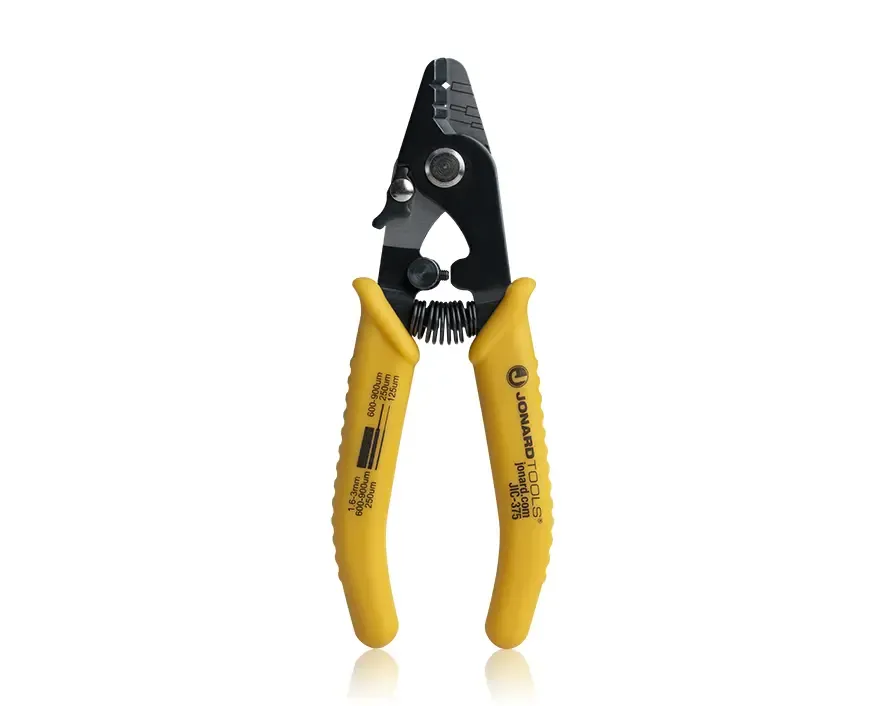
Singlemode OSP cables (loose-tube, dry-block, ripcords) and indoor tight-buffer MM cables strip very differently. Use adjustable jacket and buffer-tube strippers with indexed nests for typical ODs, and 250 μm/900 μm precision strippers that don’t nick glass. Bend-insensitive fibers can be slightly stiffer—clean, concentric scoring matters to avoid microbends.
2) Cleaving and connectorization tolerances are tighter on SM.
Even if you use factory pigtails, field cleavers and prep tools must leave pristine endfaces for fusion splicing or mechanical splices. Singlemode tolerances (particularly with APC connectors) demand repeatable blade depth and angle control. Multimode is a touch more forgiving, but high-speed links still penalize sloppy geometry.
3) Inspection & cleaning are non-negotiable.
A dust particle that “passes” on MM can fail a singlemode link. Carry 1.25 mm (LC) and 2.5 mm (SC) inspection tips, bulkhead/adaptor cleaners, and cassette sticks that match your connector family. Train techs on inspect → clean → inspect again; do not mate dirty connectors “just to test”—that’s how you ruin ferrules.
4) Test sets must be wavelength-correct and set up properly.
- Power meter & source: MM needs 850/1300 nm; SM needs 1310/1550 nm (plus 1490/1625 if spec’d).
- OTDR: Choose MM or SM modules with the right dynamic range and event dead-zone; bring launch and receive fibers (proper lengths differ for MM vs SM).
- Encircled flux (MM): Use compliant launch cords/mandrels so your 850 nm measurements match the standard, especially for Cat A links in data centers.
5) Visual fault locators and identifiers behave differently.
VFLs are useful on both types, but light leakage is often easier to spot on MM jumpers. On long SM links, you’ll rely more on OPM/OTDR and tone-ID than on red-light bleeding through jackets.
6) Labeling and polarity practices diverge at higher speeds.
Parallel optics on MM (e.g., 40/100G SR4) use MPO/MTP connectors—your cleaning/inspection tools, polarity testers, and adapter kits must support multi-fiber connectors. Singlemode CWDM/DWDM backbones introduce filter modules and monitor ports—make sure your test cords and adapters match those interfaces.
Bottom line for tool buyers: If your mix is SM backbones and MM horizontals, standardize kits per fiber type. That means two full test sets, dual-size inspection/cleaning tools, and prep tools calibrated to each jacket/buffer family. You’ll reduce failed certs, prevent damaged connectors, and speed closeouts.
Why It Matters
The singlemode/multimode decision shapes your capex (transceivers), opex (testing and maintenance), and risk (how often links fail or need rework). It also dictates the tooling standard you need to train and kit across crews. Getting it right upfront means faster activations, cleaner certification passes, and simpler upgrades later—without buying test gear twice or discovering at 4:30 p.m. that your inspection tips don’t fit today’s connectors.
Comments
Login or Register to post comments.