

Data Centers: Powering Modern Life
Every time you send an email, stream a video, make an online purchase, or ask a question to an AI assistant, the response comes from somewhere. Not the cloud, not the internet in some abstract sense, but instead a physical building, filled with servers, cooled by sophisticated systems, and connected by miles of fiber optic cable.These buildings are data centers, and the world runs on them.
For decades, data centers lived quietly in the background as the domain of IT professionals and telecom engineers. Today, they are front-page infrastructure. Governments designate them critical national assets, tech giants are pouring hundreds of billions of dollars into them, and entire regions are being reshaped around their power demands. Additionally, with artificial intelligence accelerating the need for computational power at unprecedented rates, the data center industry is entering what may be its most significant period of growth in history.
At Jonard Tools, we've spent over 65 years building the precision tools that keep fiber optic networks functioning at their best. As the world's demand for data infrastructure grows, so does our commitment to equipping the technicians and engineers who build & maintain it.
01 — WHAT IS A DATA CENTER?
More Than a Room Full of Servers
At the most basic level, a data center is a facility that houses computing infrastructure such as servers, storage systems, and networking equipment, that organizations use to process, store, and transmit data. But that description barely scratches the surface of what a modern data center actually is.
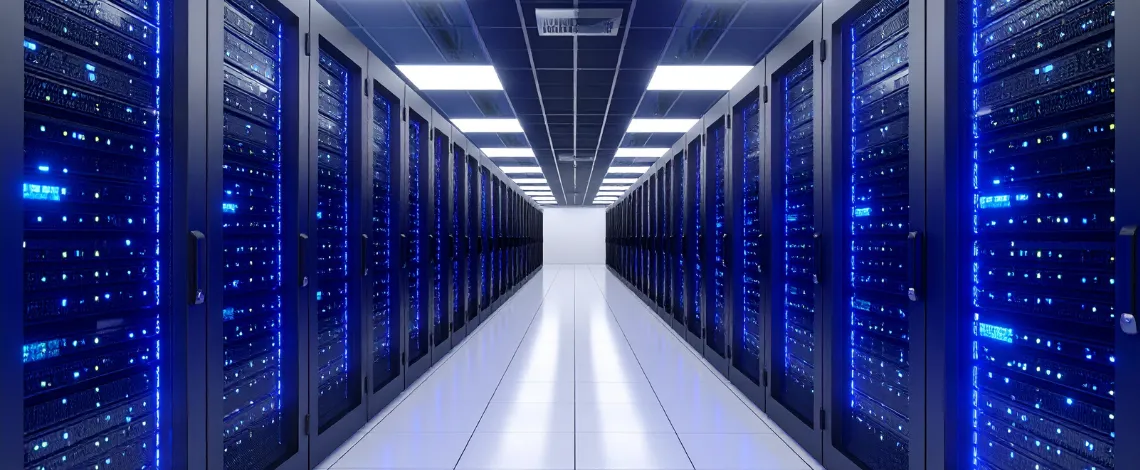
Today's data centers are engineering marvels. A hyperscale facility, the type operated by companies like Google, Amazon, Meta, or Microsoft , can span hundreds of thousands of square feet, consume as much electricity as a small city, and contain millions of individual server units connected by an intricate web of fiber optic cables carrying data at the speed of light.
How They Work
A data center's job is deceptively simple: receive requests, process them, and return results - billions of times per second, without interruption. Behind that simplicity is a layered architecture of interconnected systems:
Compute Layer | Servers & Processing: Rows of servers handle the actual computation, running applications, processing AI models, serving web pages, and storing files. Modern racks are increasingly dense, with AI GPU clusters demanding enormous power per square foot.
Connectivity Layer | Networking & Fiber: Every server connects to every other through a high-speed switching fabric, predominantly fiber optic cabling running at 100Gbps, 400Gbps, and increasingly 800Gbps. The quality of every connection directly affects throughput and uptime.
Storage Layer | Data Storage Systems: Petabytes of data (videos, databases, AI training sets, enterprise files) are stored on arrays of flash and disk storage, replicated across multiple locations for redundancy.
Physical Layer | Power & Cooling: Servers generate enormous heat. Cooling systems, from traditional CRAC units to liquid cooling and immersion systems, maintain precise temperatures. Redundant power systems ensure zero interruption, even during grid outages.
These four layers work in concert, and a failure in any one of them can cascade into significant downtime. A single dirty fiber connector can degrade signal enough to slow a network. A miscrimped termination can drop a link entirely. Precision at every layer, from infrastructure design down to individual fiber connections , is what separates a world-class data center from a liability.
03 — WHY THEY MATTER & THE GROWTH
The Infrastructure Behind Everything That Matters
Data centers aren't just important to the technology industry, they're foundational to virtually every sector of the modern economy. Consider what runs through them:
Healthcare & Life Sciences: Electronic health records, medical imaging, genomic sequencing, and AI-assisted diagnostics all depend on data center infrastructure. A hospital's ability to access a patient's records in seconds can be the difference between life and death.
Financial Services: Every stock trade, every bank transaction, every insurance claim flows through data center systems. The financial industry demands sub-millisecond latency and 99.9999% uptime, standards that push data center engineering to its limits.
Artificial Intelligence: Training a large AI model requires massive parallel computation across thousands of GPUs running continuously for weeks. AI is perhaps the single largest driver of new data center construction today, with demand for GPU clusters growing exponentially.
Communications & Media: Every video stream, social media post, voice call, and news article is served from data centers. At peak hours, a single streaming platform may serve hundreds of terabytes of video per second, all from facilities connected by precision fiber infrastructure.
Manufacturing & Logistics: Supply chains, warehouse automation, fleet management, and smart factory systems all rely on real-time data processing. The industrial internet of things (IIoT) is creating massive new demand for edge data centers closer to the point of production.
The Numbers Tell the Story
The data center market isn't just growing, it's compounding. Driven by cloud adoption, AI workloads, video streaming, and global digitization, investment in data center infrastructure is accelerating at a rate that few industries have ever seen.
- $500B+ committed by hyperscalers for data center construction in 2025 alone
- ~20% projected annual growth rate of the global data center market through 2030
- 10,000+ data centers currently operating in the United States
- $700B+ estimated global data center market size by 2030, up from ~$187B in 2020
The AI boom alone is reshaping the industry's trajectory. OpenAI, Google DeepMind, Meta AI, and hundreds of startups are all competing for GPU capacity , which means competing for data center space, power, and connectivity. Microsoft has committed to spending $80 billion on AI-capable data centers in 2025. Google has matched it. Amazon is building at similar scale.
Beyond the hyperscalers, the edge computing movement is driving construction of thousands of smaller, distributed facilities closer to population centers, reducing latency for applications like autonomous vehicles, smart cities, and real-time industrial control. This creates demand not just for massive campuses, but for fast, efficient deployment of precision fiber infrastructure at scale.
04 — JONARD'S ROLE
Built for the Infrastructure That Runs the World
Every data center, from a 10,000 sq ft colocation facility to a million sq ft hyperscale campus, is ultimately built connection by connection. Every fiber cable terminated, every connector cleaned, every link certified is hands-on work done by skilled technicians who depend on tools that perform flawlessly under pressure.
That's where Jonard Tools has been for over 65 years. Trusted by professionals in more than 100 countries, our tools are built to the standard that high-stakes fiber infrastructure demands - surgical precision, field-proven durability, and the confidence of a lifetime warranty behind every product.
Here's what we bring to the data center environment specifically:
Fiber Cleaning : The Most Overlooked Critical Step
In a data center, a contaminated connector is not a minor inconvenience, but instead a signal loss event waiting to happen. Studies show that up to 85% of fiber network failures are caused by dirty connectors. Our cleaning solutions off everything from fiber connector cleaners, dry wipes, and cleaning fluids that give data center technicians the tools to eliminate contamination before it becomes downtime.
Mid-Span Access Tools
Dense cable management in data centers means working with live, heavily-packed cable bundles. Our mid-span access tools allow clean, precise access to individual fibers within a bundle, all without damaging adjacent cables or creating unnecessary slack.
Precision Strippers & Cleavers
LC and MPO connectors dominate data center environments. Our strippers and cleavers are engineered for the dimensional tolerances these connectors demand, removing manual adjustment from the equation and delivering consistent, certifiable results every time.
Termination & Crimping Tools
High-volume data center buildouts demand termination tools that eliminate variation. Our universal compression tools are built for speed and consistency across connector types, reducing rework and keeping deployments on schedule.
Test, Inspection & Diagnostics
Our visual fault locators, optical power meters, and fiber inspection scopes let technicians locate faults and validate performance, the final step before any connection goes live in a production environment.
Our approach to the data center market mirrors what we've always done: put the best possible tools in the hands of the professionals building critical infrastructure, stand behind them with a lifetime warranty, and earn the reputation that keeps us specified on the next job. Whether it's an instructor training the next generation of BICSI-certified technicians or a field team commissioning a new hyperscale wing, Jonard is there — connection by connection.
Jonard
Comments
Login or Register to post comments.