
Cable Installation: Most Essential Tools
A clean, code-compliant cable installation, whether coax, Ethernet/Cat6/6A, or fiber optic, depends on methodical routing, careful prep, and verifiable testing. The right tools don’t just make the work faster; they make results repeatable across crews and job types. Below are nine must-have tools for structured cabling, CATV, and low-voltage work, outlining how they work and why they are so important for the job.
1) Fish Tape

What It Is
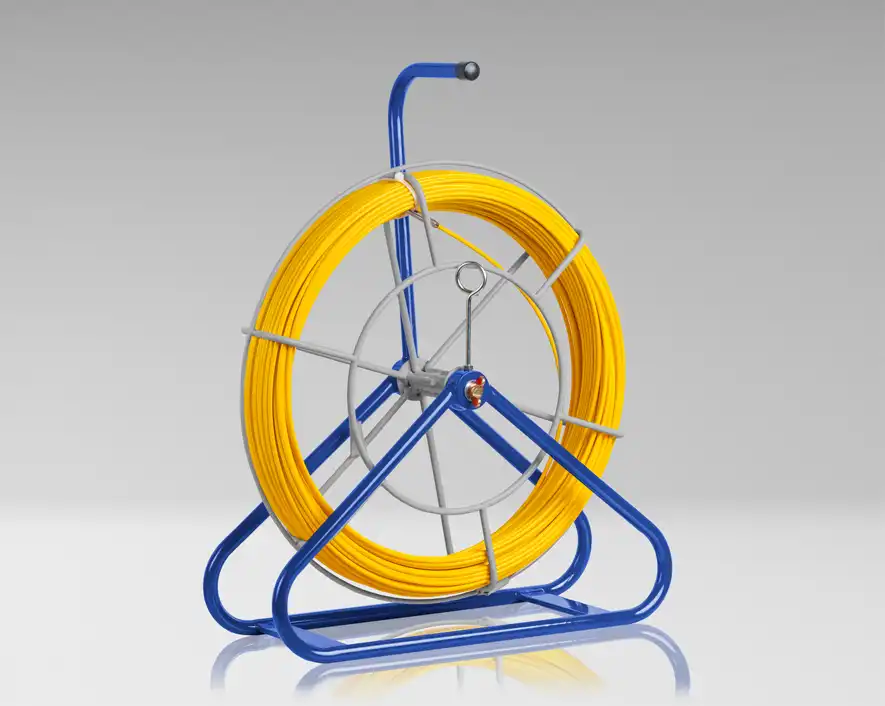
A fish tape is a semi-rigid guide housed in a reel, built to navigate conduits and wall cavities to establish a pilot path. Steel tapes deliver high column strength for long, straight runs, while fiberglass versions are non-conductive and safer around energized gear. Quality reels include smooth feed mechanisms, replaceable leaders, and printed length markings so techs can gauge distance without guesswork.
What It Does
You feed the tape through the raceway until it emerges at your target, then fasten a pull string or cable to the leader and reel it back. Interchangeable leaders—ball, flexible, or hook—help glide past couplings and tight bends or “catch” a string inside a cavity. Because the tape resists buckling, it can be twisted to steer through offsets, making blind pulls more predictable and reducing the need to open walls or ceilings.
Why It Matters
Pathfinding is often the most uncertain part of a retrofit. Fish tape turns a hidden interior into a mapped route, lowering the risk of jacket damage and drywall repairs. Over a full day, fewer false starts and cleaner first passes translate into more completed terminations, steadier schedules, and fewer return visits caused by kinked or abraded cable.
2) Fiberglass Push/Pull Rods
What It Is
Push/pull rods are lightweight fiberglass sections—often glow-in-the-dark—that thread together into a steerable probe for ceilings, soffits, and horizontal voids. Sets typically include bullet noses, hooks, magnets, and flexible couplers that allow gentle bends without losing directional control. Many kits store compactly but extend 15–30 feet when assembled.
What It Does
Where fish tape tends to drop or spring back, rods let you place a leader precisely across a ceiling bay or above a corridor. The tips retrieve chains or strings, bridge gaps, and hand off to the next access point with minimal disturbance. In dim plenum spaces, glow rods provide visual confirmation from the floor, reducing ladder time and miscommunication between the spotter and the person feeding the path.
Why It Matters
When no conduit exists, rods transform chaotic overhead spaces into manageable routes. They reduce ceiling tile handling, prevent jacket scuffing over rough edges, and speed distribution in MDUs and offices. That control keeps finish spaces intact and helps crews hit daily footage goals without trading away workmanship.
3) Cable Puller

What It Is
A cable puller is a mechanical assist—capstan stands, portable tuggers, or drill-powered devices—that delivers steady, controllable pulling force for long or high-friction runs. Rated capacities range from a few hundred pounds (handheld) to several thousand (capstan), with speed control and foot pedals to keep hands clear of pinch points.
What It Does
Paired with grips, swivels, sheaves, and lubricant, the puller maintains even tension so bundles glide through bends without corkscrewing. Operators can pause to add lube, re-align sheaves, and restart smoothly, preventing shock loads that crush coax dielectric or distort copper twist lay. Consistent speed also limits jacket heating on long pulls, preserving performance and avoiding hidden damage.
Why It Matters
Manual pulling is slow, inconsistent, and fatiguing—especially with multi-cable bundles or several 90s. A controlled pull protects cable, reduces crew strain, and turns “hero pulls” into routine production. The result is fewer mid-run failures, cleaner terminations at the far end, and schedules that hold even on complex retrofits.
4) Adjustable Cable Jacket/Buffer-Tube Stripper

What It Is
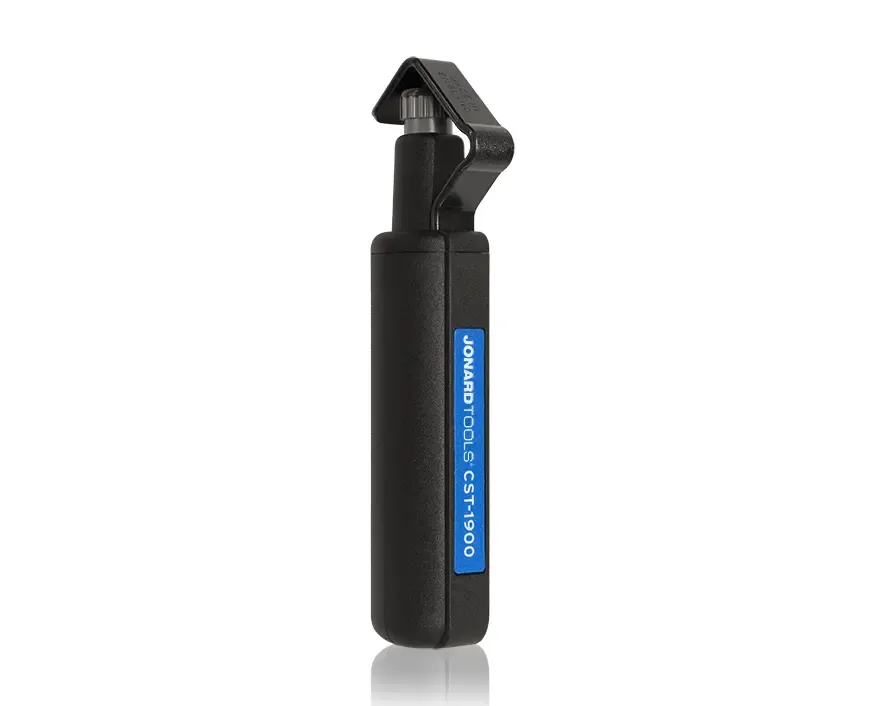
This precision tool uses indexed nests and adjustable depth to score polymer jackets and, in fiber work, buffer tubes. Better designs offer spiral and longitudinal modes, quick-change cartridges for common diameters, and tactile detents that prevent over-cutting. Handles and housings are shaped to shed gel and debris for reliable operation in the field.
What It Does
Set the correct channel and depth, then score the jacket so it peels cleanly without nicking braid, conductors, or glass. Spiral cuts handle thick or stubborn jackets; longitudinal cuts create tidy windows for mid-span access. Repeatable geometry across dozens of ends means uniform prep times and fewer surprises when you move to termination.
Why It Matters
Knife marks and over-cuts are silent killers that reveal themselves later as attenuation or intermittent faults. A purpose-built stripper delivers consistent, damage-free prep, reducing scrap and rework across coax, copper, and fiber. That reliability keeps crews in rhythm and improves first-time pass rates on testing.
5) Ratcheting Cable Cutters

What It Is
Ratcheting cutters use hardened blades and a geared mechanism to deliver square, round cuts on copper or aluminum cable with minimal hand force. Compact models serve low-voltage and coax; larger frames handle big conductors. They’re not intended for steel armor—specialized armoring tools cover that task.
What It Does
The ratchet advances blades incrementally, preventing slippage and egg-shaped ends. You get a burr-free face ready for stripping or connectorization, and on coax the dielectric remains centered for consistent impedance. One-handed control keeps the other hand free to manage the cable, improving safety and speed in tight spaces.
Why It Matters
Every termination begins with the cut. Out-of-square or crushed ends cause poor connector fit, stray strands, and intermittent performance. Clean cuts shorten prep, reduce connector waste, and eliminate a common source of callbacks—especially noticeable on high-volume projects.
6) Coax Compression Crimper
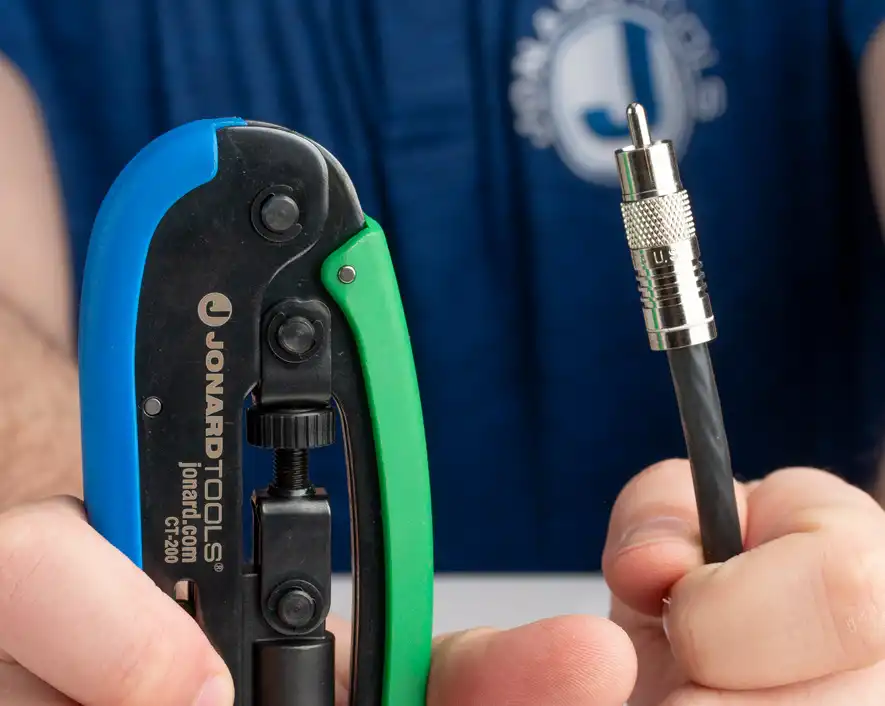
What It Is
A compression crimper applies a calibrated stroke to set F-type, BNC, or RCA compression connectors on RG-series coax. Frames may be fixed or adjustable to match body lengths and styles across brands, and many include quick-change dies for fast transitions on mixed-connector jobs.
What It Does
After correct stripping and seating, the crimper compresses the ferrule evenly, locking it to jacket and braid while maintaining 360° shield continuity. Proper compression preserves impedance, resists moisture ingress, and provides high pull-out strength. The consistent geometry also stabilizes return loss and minimizes signal egress that can invite interference.
Why It Matters
CATV, satellite, and surveillance signals depend on termination quality. Inconsistent crimps invite pixelation, noise, and service calls. A good compression tool standardizes results across crews, cutting truck rolls and keeping signal levels in spec, which protects both margins and reputation.
7) RJ45 Modular Crimper
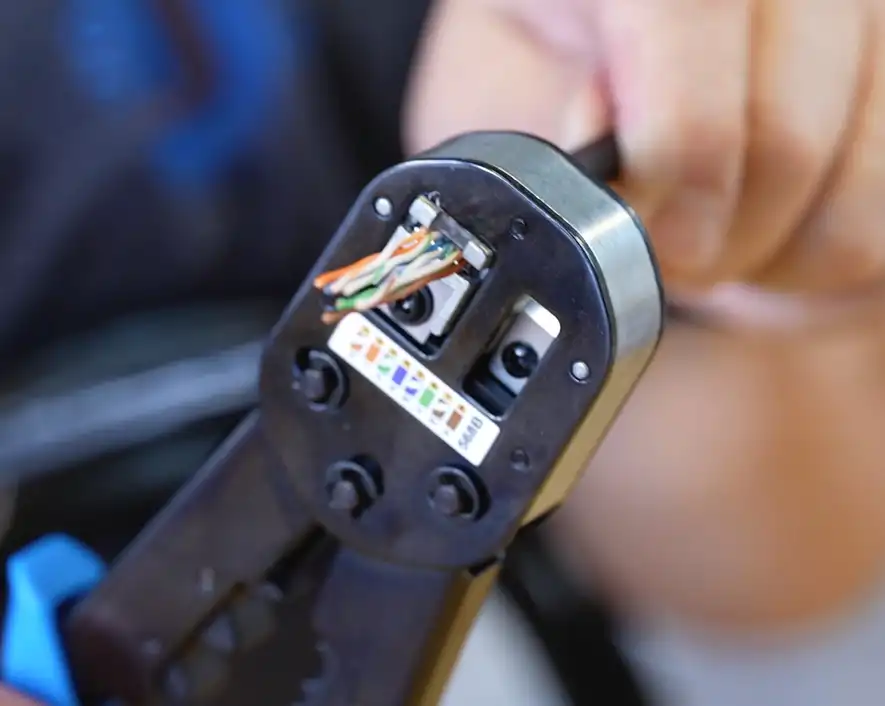
What It Is
An RJ45 crimper terminates twisted-pair cable to 8P8C plugs for Cat5e/Cat6/Cat6A. Professional frames combine cut/strip/crimp, support pass-through or standard plugs, and include jacket-grip strain-relief. Matching plug families to conductor type and cable OD is part of the system.
What It Does
The tool seats contacts uniformly so each blade pierces insulation without deforming the conductor, and it secures the boot to grip the jacket. Pass-through styles allow a visual check of conductor order before trimming, reducing wiring errors. Done right, pair geometry is preserved right up to the plug, supporting category performance during certification.
Why It Matters
Unreliable field plugs waste time and erode confidence in the whole plant. Precision crimps produce predictable Ethernet performance, fewer bad ends in a batch, and less detective work when a link fails to train. On dense projects, that consistency is the difference between finishing on the plan and falling behind.
8) Punchdown Tool
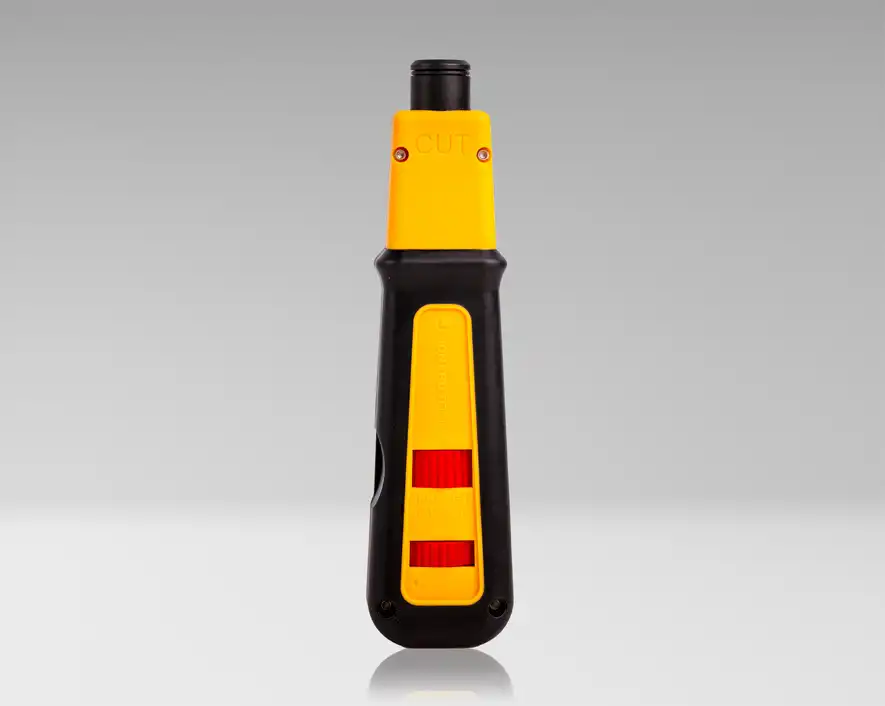
What It Is
A punchdown tool seats and trims conductors into insulation displacement contacts on 110/66 blocks and keystone jacks. Interchangeable blades offer “cut” and “non-cut” edges, and adjustable impact settings tailor seating force to the hardware to avoid cracked housings or shallow terminations.
What It Does
With a single press, the tool drives the conductor to the correct depth while trimming excess flush, preserving twists as close as possible to the contact. The spring mechanism delivers uniform force across hundreds of pairs, preventing half-cuts and insulation pull-back that cause intermittent faults.
Why It Matters
Patch panels and faceplates are the backbone of structured cabling. Consistent IDC terminations safeguard category performance and speed certification. Standardizing on a reliable punchdown process keeps workmanship uniform across techs and shifts, which simplifies troubleshooting and future MAC work.
9) Tone Generator & Probe (Tracer)
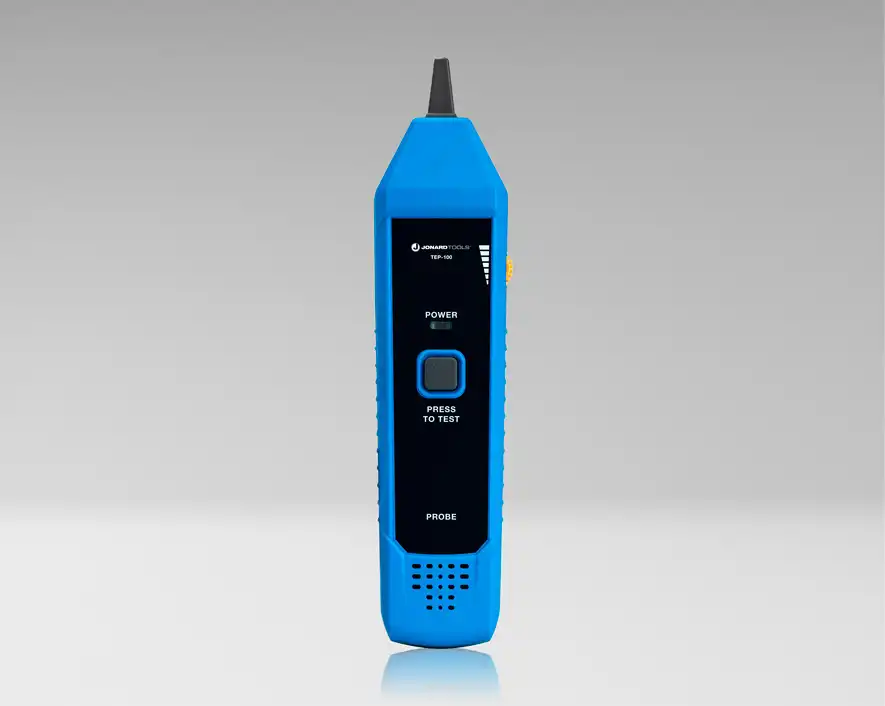
What It Is
A toner/probe kit injects an audible signal onto a cable pair and lets you detect that tone along the run or at the far end. Professional probes add noise filters to reject 50/60 Hz hum, adjustable gain for crowded closets, and tips shaped to differentiate adjacent conductors in bundles.
What It Does
Attach the toner at a known point, then sweep trays, bundles, or outlets with the probe to identify the exact conductor without dismantling panels. Many toners also provide continuity and polarity checks, with modular leads and RJ adapters to connect to legacy and modern terminations. The net effect is fast, non-destructive identification in real-world noise.
Why It Matters
In existing buildings, finding the right drop is half the job. Accurate tracing prevents mis-cuts, reduces time above ceilings, and keeps moves/adds/changes on schedule. With filtered probes, you avoid false positives in noisy environments, saving hours and avoiding embarrassing “wrong drop” moments.
Conclusion
Cable installation is a repeatable process: route, pull, prep, terminate, test, label, document. The tools above make each step safer and more predictable, allowing crews to deliver code-compliant results with fewer callbacks and tighter schedules. Standardize how your team uses them, and you’ll see the payoffs in productivity, certification pass rates, and client satisfaction.
Comments
Login or Register to post comments.